
How to Clean Your Aircon Filter
Share
Cleaning your aircon filter takes about ten minutes and makes an immediate difference to airflow, running costs, and the air quality inside your home. Pull the filter out, vacuum off the dry dust, rinse it under warm water, let it dry fully, then put it back. That's the short answer.
If you want to do it properly and understand what a filter clean actually fixes versus what it doesn't, here's everything you need to know.
Why a dirty aircon filter is more expensive than you think
Your aircon filter sits at the front of the indoor unit and catches dust, pollen, pet hair, and airborne particles before they reach the internal components. Every bit of air your system moves passes through it.
When the filter gets clogged, several things happen at the same time. Airflow drops, forcing the unit to work harder to push air through. That extra effort can add up to 30% to your power bill without you changing how you use the unit at all. Dust starts bypassing the filter and landing on the evaporator coil behind it. Moisture gets trapped. That combination of dust and dampness is exactly how mould establishes itself inside the unit, and once it does, the smell comes with it every time the fan runs.
Staying on top of the filter is the cheapest, easiest thing you can do to keep the whole system running well. It's also the thing most people skip for six months longer than they should.
What you'll need
Nothing you don't already have. A vacuum cleaner with a brush attachment, warm water, and a small amount of mild dish soap if the filter is particularly grimy. That covers a standard filter clean from start to finish.
How to clean a split system aircon filter
Step 1 — Turn the unit off at the wall Switch it off at the remote first, then at the wall switch or isolator. The front panel is about to come open and you don't want the fan running while you're working inside the unit.
Step 2 — Lift the front panel The cover on most split system indoor units hinges upward from the bottom edge. Lift it gently until it clicks into the open position. You'll see two mesh filter panels sitting parallel to each other inside.
Step 3 — Remove the filters They lift or slide straight out without much resistance. Before you pull them, take a photo of how they're positioned. Some filters have a specific orientation and getting them back in correctly matters for airflow.
Step 4 — Vacuum before you add any water This step gets skipped constantly, and it's the one that makes the rest of the clean easier. Run a vacuum with a brush head over both sides of the filter to pull off the dry dust. If you go straight to rinsing without doing this first, the dry dust turns into a thick paste that blocks the mesh and is harder to rinse out than the original build-up.
Step 5 — Rinse under warm running water Hold the filter under a running tap and let the water work through the mesh from both sides. For a filter that hasn't been cleaned in a while, a short soak in warm water with a small amount of dish soap helps loosen the grime before you rinse. Keep rinsing until the water running off it is clear.
Go easy with the pressure and avoid scrubbing hard. The mesh is more fragile than it looks and aggressive cleaning can stretch or tear it.
Step 6 — Dry it completely before putting it back This is the step people rush, and rushing it causes problems. A wet filter reinstalled into the unit creates exactly the damp environment mould needs inside the housing. Shake off as much water as you can, then leave the filter in a shaded spot with decent airflow. Outside in the shade is ideal. Give it two hours minimum and keep it out of direct sunlight, which can warp the plastic frame.
Step 7 — Reinstall and close the panel Slide the dry filters back in the same orientation as when they came out, close the front panel until it clicks, and turn the unit back on.
How to clean a ducted aircon filter
Ducted systems work a little differently. The filter sits behind the return air grille, a large louvred panel usually on the ceiling in a hallway or main living area. If you're not sure which grille it is, turn the system on and run your hand near each one to feel which is drawing air inward.
Turn the system off at the wall controller before you start. Then:
- Release the latch or clips on the return air grille and let it swing open
- Slide the filter out carefully and take it outside before shaking or vacuuming it
- Vacuum off loose dust, then rinse gently with a hose at a slight angle to avoid damaging the mesh
- Leave it to dry fully in the shade
- Slide the filter back into position, close the grille, and turn the system back on
The process is straightforward but ducted filter frames can be large and awkward to handle on a ladder, so take your time.
How often should you clean your aircon filter?
For most Australian homes, every three to six months is the right interval. A few things push that closer to three months:
- You run the unit heavily through summer
- You have pets that shed
- Anyone in the house has asthma, hay fever, or dust allergies
- The unit is in a dusty room or close to a busy road
A simple habit that works well is to clean the filter at the start of summer before heavy use kicks in, and again at the end of summer before you switch over to heating mode. That way the unit is always going into its peak period with clean airflow.
If you skip the filter too long, it's not just a comfort issue. A blocked filter can ice up the coil in cooling mode or cause the unit to overheat and shut itself down. Read more about how a dirty filter can stop your aircon working if you've been dealing with that.
What a filter clean doesn't fix
Here's what most guides leave out. The filter catches particles before they reach the internal components, but it doesn't catch everything. Over time, fine dust still settles on the evaporator coil sitting directly behind it. That coil stays damp from normal condensation during operation. Dust plus moisture on a surface that rarely fully dries is how mould takes hold inside the unit.
By the time your aircon has a musty smell, reduced airflow, or is taking longer than usual to cool a room, the filter is no longer the source of the problem. The coil, drip tray, blower wheel, and drainage channel are, and those need a different approach to fix. If you're already dealing with the smell, read about why your aircon smells musty and how to clear it properly.
Signs your unit needs a deeper clean beyond the filter:
- Musty or stale smell when it runs, even after a fresh filter clean
- Weaker airflow than it used to have
- Longer to cool or heat the room than before
- Visible grime or dark residue inside the unit when the panel is open
- Power bills creeping up without any change in how you use the unit
A filter rinse won't reach any of those areas.
When you need a full internal clean
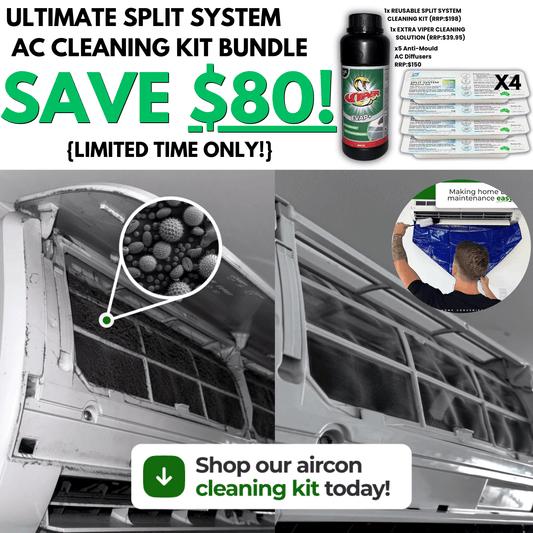
A complete clean covers the parts where mould and dust actually accumulate. That's the evaporator coil, blower wheel, drip tray, and drainage channel. It involves applying a coil-safe cleaner, working through the internal surfaces, and flushing everything through properly.
Our DIY aircon cleaning kit includes everything you need to do this yourself without calling a tradie. It comes with Viper Evap+ professional-grade coil cleaner, a catchment bag to protect your walls and floor, brushes to reach deep into vents, a pump bottle, microfibre cloths, and a collapsible bucket. The full clean takes most people under 30 minutes and the kit is reusable, so you're not paying a call-out fee every time the unit needs attention.
If you've cleaned the filter and the performance or smell problem is still there, a full internal clean is the next step.
The short version
Clean the filter every three to six months. Vacuum it dry first, rinse with warm water, and dry it completely before reinstalling. For ducted systems, the filter is behind the return air grille on the ceiling and the process is the same.
If the smell or performance issue persists after a filter clean, the problem is inside the unit. A full coil and internal clean is what actually fixes it, and you can do it yourself in under 30 minutes with the right kit.
Shop the DIY Aircon Cleaning Kit